
The Sermon on the Mount
 “The Sermon on the Mount is not a statement to be treated in a cavalier fashion — by saying that this or that isn’t right or that here we find an inconsistency. Its validity depends on its being obeyed. This is not a statement that we can freely choose to take or leave. It is a compelling, lordly statement.” – Dietrich Bonhoeffer
– Brian
“Seeing the crowds, he went up on the mountain, and when he sat down, his disciples came to him. And he opened his mouth and taught them.” – Matthew 5:1-2
Membership Has Its Privileges
 If you were around during the late 80’s and early 90’s the phrase, “Membership has its privileges” is probably familiar to you. It was a time when credit cards were really taking root in our society, and American Express was trying to set itself apart from the others. They did not want their customers to think of themselves as simply cardholders, but as members of a club. In each ad, that tagline about membership was mentioned. They showed how membership came with status and rewards, but they did not usually mention that it also came with a bill at the end of the month. It was a memorable ad campaign.
- I will be a functioning church member. There is work to be done and a world to be reached. It is up to all of us to do it.
- I will be a unifying church member. Jesus prayed for our unity. He knew the church would be at its best when we are one.
- I will not let church be about my desires and preferences. This may be the toughest one on the list, but it is every bit as important as the others. Paul spent a lot of time writing about this problem in the New Testament. We have to consider others above ourselves. We have to make things about God’s desires and preferences.
- I will pray for my church leaders. This book was written long before any of us heard about COVID-19 or all the adjustments congregations would have to make. Church leaders needed prayer then, and they definitely need it now.
- I will lead my family to be healthy church members. Be the example of all these things to those who are closest to you. The church today and tomorrow need that example.
- I will treasure church membership as a gift. I love the fact that God does not only care about how we interact with Him, but He also wants us to love one another. He provided the church so that we could live in that loving community. Jesus is an amazing gift. Eternal life with Him will be an amazing gift. The church is a gift too. We should always think of it that way.
“Now you are the body of Christ and individually members of it.” – 1 Corinthians 12:27
Let Freedom Ring
 I have always enjoyed the 4th of July. Since I was a kid, I l have loved watching fireworks shows. As a trumpet player, I enjoy the patriotic songs and Sousa marches. Since moving to Ada, I appreciate turning onto Main Street and seeing all the flags out. I have always felt blessed to live in the “land of the free and the home of the brave.” We celebrate that independence every year, but it is not the greatest freedom we can have as Christians.
- Jesus gives freedom. Jesus understands better than anyone what the lack of freedom does. He was there in the beginning and knew what happened when people took the freedom of others or lost their own. For the people of His time, He brought freedom from the old covenant and hope in the new one. “It is for freedom that Christ has set us free.” (Galatians 5:1)
- The presence of the Spirit gives freedom. When our lives show clear evidence of the fruit of the Spirit, we are freed from a myriad of problems. With His guidance, we can be freed from even more. “Now the Lord is the Spirit, and where the Spirit of the Lord is, there is freedom.” (2 Corinthians 3:17)
- Following Jesus gives freedom. People convince themselves that sin brings pleasure, fun and no limits. Instead it actually binds and enslaves. Living as disciples frees us. “Jesus replied, ‘Very truly I tell you, everyone who sins is a slave to sin. Now a slave has no permanent place in the family, but a son belongs to it forever. So if the Son sets you free, you will be free indeed.’” (John 8:34-36)
- Freedom is not free. We have seen that phrase on t-shirts and bumper stickers, but it is clearly taught in scripture. Jesus gives us freedom, but it is not without a price. It was paid for with His sacrifice. “Christ redeemed us from the curse of the law by becoming a curse for us, for it is written: ‘Cursed is everyone who is hung on a pole.’ He redeemed us in order that the blessing given to Abraham might come to the Gentiles through Christ Jesus, so that by faith we might receive the promise of the Spirit.” (Galatians 3:13-14)
- The gospel still gives freedom. We must tell the story of Jesus, so that others can enjoy the same freedom we do. Ironically the book of Acts ends with Paul freely teaching others how to receive the liberty the gospel provides, while he was imprisoned. The Greek word that describes how he taught means to speak freely and boldly. “He proclaimed the kingdom of God and taught about the Lord Jesus Christ—with all boldness and without hindrance!” (Acts 28:31)
Why Are We Here?
 We can say many things about story of Jesus, but one thing is clear. Coming into contact with the gospel demands a reaction. It is not something that many can be neutral about. The people of Ephesus learn that through the uproar that happens in Acts 19.
Catalyst
 Several terms have been added to our conversational vocabulary since March: social distancing, unprecedented, the new normal, COVID-19. I would like to add another one: catalyst. It is a word usually used to describe part of a chemical reaction, but it has another meaning. According to Webster’s Dictionary, a catalyst is an agent that provokes or speeds significant change or action. Usually in traditional church circles we do not have positive thoughts when we see the words change and agent in the same sentence, but some of the changes brought on over the last few months could be positive if we allow them to take root.
- Reducing consumerism (Matthew 6:24) – We think of this more in terms of materialism. When everything shuts down, it is a little harder to go shopping. Although this has created challenges for small business owners, it has also forced people dealing with debt to reassess how they spend. No one can serve two masters.
- Slowing down and putting less pressure on ourselves (Matthew 6:25-34) – Many of the things that we pressuring us in February had to be put on hold. The pace of life for most of us changed drastically. That slow down can help us notice others and see God more clearly.
- Prioritizing family and friends (John 13:34-35) – Finances are not the only place we have been forced to assess what is really important. We have realized how important our relationships are, and we have spent a lot of time with those people who live in our homes.
- Eating meals together (Ephesians 5:22-6:4) – Sitting at the table and sharing a meal together was not a regular practice in many families before COVID-19. People are busy. Even if they were in the same house, they might eat at different times in different rooms. Slowing down has also brought the opportunity to sit a table together. There is a great benefit from that.
- Spending time in nature (Psalm 19, Psalm 95) – When things shut down, one of the few places we could go was outside. We had the opportunity again to enjoy the feeling of the sun on our faces and to hear the sounds of nature around us. We serve a powerful God who made all of this.
One Another
 On Wednesdays this summer, we are having our usual summer guest speaker series in an unusual way. Each Wednesday you can find our guest speaker’s video lesson on our Facebook and YouTube pages. David Dirrim and I had already begun planning for our theme and speakers before our routines and meetings changed. We had chosen the theme, “One Another” for this summer. Since March, it has become very clear to all of us just how important those “one another” relationships are in our lives. As we have faced social distancing and racial tensions in our nation, we know that having the kind of relationships that God desires will take some effort on our part.
- Their love for other Christians was a blessing (Ephesians 1:16). One of the things Paul was thankful for was that love. It not only helped their interaction, but it served as an example for others.
- The blood of Jesus has the power to reconcile groups that were once separate (Ephesians 2:11-18). The church at Ephesus may have struggled because they came from different backgrounds, but those who once felt apart were now welcome. In the midst of our national racial struggles, this is a powerful message. God intends to bring a peaceful whole out of splintered groups.
- They are fellow citizens of God’s kingdom (Ephesians 2:19-22). People who might otherwise have nothing in common now had a reason to be unified. Being part of God’s family supersedes all our other affiliations.
- Their love for one another would help them know Christ better (Ephesians 3:14-19). Following Jesus was always intended to be a team event. Although there is a personal side to that relationship, it is never fully what it could be without the community of believers.
- They needed to continue striving for unity (Ephesians 4:1-6). Paul told them to live a life “worthy of the calling to which you have been called.” Usually when we talk about something like that, we tend to talk about behaviors and avoiding sin. Paul talks about unity, humility and patience. Living a life that honors God always includes treating one another well.
- They had to watch their words, not just their actions (Ephesians 4:25-32). Our words can easily build up or tear down. We must choose them well, keep them honest and make them positive.
- How they treated one another began at home (Ephesians 5:1-6:9). We cannot forget those who are closest to us when we want to treat one another in a way that honors God. He wants that same love, kindness and respect to be the foundation of our family interaction.
- Praying for each other is essential (Ephesians 6:18-20). We pray for each other when struggles and loss come into our lives, but let’s not forget to pray for one another regularly. Paul begins the letter talking about his regular prayer for them and ends it by reminding them to do the same.
Faith for Exiles
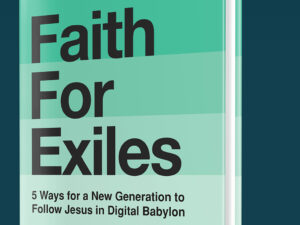 With all the talk lately about the similarities between the exile and our recent pandemic, I almost forgot that there were many similarities between exile and the life of a Christian before the pandemic began. Sometimes we feel as if we are exiled to a different place as the culture shifts around us, even though we have not left our homeland.
- Resilient disciples have a close relationship with Jesus. Through good times and bad our connection to the vine will help us to grow and provide what our faith needs.
- Resilient disciples consistently discern the good and bad in culture. We have to engage our culture at some level. Rather than run away like Jonah, we can learn and teach within it like the apostles.
- Resilient disciples have good intergenerational relationships. Scripture often emphasizes the importance of the relationships between younger and older followers of God. Those teachings still hold true.
- Resilient disciples are disciples within the workplace and other parts of life. It has never been clearer than it is now that our Christianity extends far beyond 505 West 17th Street. We must make Jesus a part of our jobs, homes, schools, neighborhoods and friendships.
- Resilient disciples are countercultural by being selfless. According to Philippians 2, this is the way Jesus approached His incarnation. It is what He taught in the Sermon on the Mount. It is how we can help the world around us see Him more clearly.
Structure
 I was curious this week what I had written about for this space the week before COVID-19 changed things. The March 15 bulletin had an introduction for our missionary in Scotland who spoke that evening, so I had to go back another week to March 8. That article was about Paul’s shipwreck in Acts 27 and how he relied on faith in God in a time of crisis. I tried to challenge you with these thoughts in the closing: “When the winds and waves in our lives try to overtake us, let’s recognize that as a chance to show our trust in God. Let’s be an example to others how God can still work through the storms. Let’s remember that He still does exactly what He says.” I had no idea how much those words would apply over these two months.
One of the many challenges in the midst of this pandemic has been the change in or lack of structure. For parents whose kids were in school, they have been at home. Many have begun to work from home. Some have used grocery pick up for the first time. We’ve worried for the first time in our lives about if we could find toilet paper at the store. People are working from home. Even those whose job schedules have not changed have become more familiar with masks and six foot separation. We have learned about live streaming and Zoom and sang hymns along with videos. We haven’t been able to visit each other in person. Our regular times together at the church building went away for a while and are now anything but regular. The change in routine is one of our storms. I did not realize that two months earlier God was providing a tool to help me weather the storm.
In January, I started working on a rule of life. I have found that the structure of that rule has been invaluable in an unstructured time. Tod Bolsinger describes a rule of life this way: “Rules of life are made up of intentional spiritual practices and commitments that serve as a trellis supporting the branches that are connected to the vine, Jesus (John 15), in order to have a fruitful life of discipleship. It is not a set of regulations that followers of Jesus must adhere to in order to be saved or experience grace but rather a support system that enables one disciple to respond faithfully to the grace of the Spirit in ways that further growth and effectiveness in a life of following Jesus.” To simplify, a rule of life is a list of practices that help us to grow in our relationship with God and live the abundant life Jesus calls us to live (John 10). Writing these practices down and making times and places for them has been especially helpful for me.
So what should be in your rule of life? That’s up to you. It might include some of the disciplines we talked about on Sunday evenings earlier this year like prayer, study or fasting. It might include better awareness of the fruit of the Spirit in our lives. It might include more intentional time with family. Being at home forced that on many of us anyway, but how are we using that time? It might include efforts to be more positive or encouraging. It might include being a better listener, being more careful with words or being fully present with people around you. It could even include taking better care of yourself physically with nutrition, exercise or sleep. It could be a list or a couple paragraphs. It has the flexibility to be adapted as needed. If like me you’ve never done anything like this before, try it anyway. You might be surprised.
Instead of being intent on getting back to normal, let’s all make use of the reset this pandemic has provided. Let’s make our new normal better than what we had before.
– Brian
Therefore, if anyone is in Christ, he is a new creation. The old has passed away; behold, the new has come. – 2 Corinthians 5:17
Identity
 Identity is a word we hear thrown around often in our world today. We hear it attached to ethnicity, nationality, gender, politics, school affiliation and a number of other things. While driving my mother back from a medical appointment this week, she noticed that the car in front of us had an Oklahoma license plate that looked different than most that she has seen. I explained that various tribes have unique license plates. It’s another way of marking identity. Psychology Today describes identity in this way: “Identity encompasses the memories, experiences, relationships, and values that create one’s sense of self.” As Christians, what is our identity? I like to think of it in terms of two things: who we are and what we do. If we wanted to describe it using two concise words, I would use awareness and intentionality.
Private Faith in Public
 This week I read about privatization. Usually when we see that term, it refers to taking something that is done by our government and having it done by private company. Instead I was reading about the privatization of Christianity. The idea of a personal relationship with God sounds like a good thing, but as that faith becomes more personal it often becomes more private. A life intended to be a city on a hill instead becomes hidden away. As this happens, our world gets used to not seeing our faith, and as a result our faith becomes unwelcome in their eyes. Peter Berger put it this way. “Faith does not simply have a new home in our private lives; it is no longer accepted outside of that sphere.”