

Jesus and Us
 Jesus came to earth to be God with us (Matthew 1:23). He came to bridge the gap that came between God and people in Genesis 3. He came to offer us salvation through Him. Scripture tells the story of Jesus and the hope He gives to us.
Jesus. From the genealogy that led to Him in Matthew’s opening chapter to His profound remodeling of the old law in the Sermon on the Mount to His miracles to the prophecies of what was to come, it has always been about Jesus. In fact, John’s gospel makes it clear that Jesus existed in the beginning, long before the time He became flesh (John 1:1,14). He is eternal. Paul tells us that He is of utmost importance. “For I decided to know nothing among you except Jesus Christ and him crucified” (1 Corinthians 2:2).
Us. Although Jesus is not speaking to us directly, His warnings about the end of the age still holds truth for us. We will likely fall into one of the two categories He describes. “The love of many will grow cold. But the one who endures to the end will be saved” (Matthew 24:12b-13). Will we be the many whose love grows cold or will we endure? My prayer is that we will be the latter.
And when we endure, it is amazing what happens. “And this gospel of the kingdom will be proclaimed throughout the whole world as a testimony to all nations, and then the end will come” (Matthew 24:14). Are you proclaiming the gospel every week? This is not a guilt trip about evangelism. It is a reminder of how important sharing the love of Jesus is for the world around us. The last third of Matthew’s gospel has repeated references to the sacrifice Jesus made and multiple parables warning His followers to be ready. We live that message in our daily lives, and we participate in a symbol of it each Sunday. According to Paul, you are proclaiming the gospel every time you share in the Lord’s Supper. “For as often as you eat this bread and drink the cup, you proclaim the Lord’s death until he comes” (1 Corinthians 11:26).
Brian
“That I may know him and the power of his resurrection, and may share his sufferings, becoming like him in his death, that by any means possible I may attain the resurrection from the dead.” Phil. 3:10-11
Becoming All Things
 Over the past few years, the last weekend in February and the first weekend in March have become some of my favorite weekends. The Telling the Story Conference in Dallas and the Affirming the Faith Seminar in Oklahoma City are highlights of the year and are great opportunities to get together with other Christians, enjoy great singing and learn from uplifting messages. This year, their themes combine well for those of us who want to share the message of Jesus with others. Telling the Story always centers on evangelism and the gospel. Affirming the Faith has a theme this year about building bridges to better understand, love and share the gospel with our current culture.
As I think about gospel and culture, I am drawn to Paul’s words about sharing the gospel in 1 Corinthians 9:19-23. “For though I am free from all, I have made myself a servant to all, that I might win more of them. To the Jews I became as a Jew, in order to win Jews. To those under the law I became as one under the law (though not being myself under the law) that I might win those under the law. To those outside the law I became as one outside the law (not being outside the law of God but under the law of Christ) that I might win those outside the law. To the weak I became weak, that I might win the weak. I have become all things to all people, that by all means I might save some. I do it all for the sake of the gospel, that I may share with them in its blessings.”
It is a difficult thing to truly listen to and understand others who are different. Paul takes the time to know his audience, because the gospel matters more than their differences. He knows how valuable that connection and relationship can be when telling someone the good news of Jesus. Sharing about Jesus is something that we are called to do. If we begin by listening, it might help people hear His message more clearly. We “do it all for the sake of the gospel.”
Brian
So Paul, standing in the midst of the Areopagus, said: “Men of Athens, I perceive that in every way you are very religious. For as I passed along and observed the objects of your worship, I found also an altar with this inscription: ‘To the unknown god.’ What therefore you worship as unknown, this I proclaim to you. – Acts 17:22-23
Ten
 If you are on track with the daily Bible reading plan so far, you read something that is likely very familiar to you this week. In Exodus 20, we find the account of Moses receiving the ten commandments. In our focus on the commandments themselves, we might forget the first two verses of the chapter that explain the foundation they are built on.
“And God spoke all these words, saying, “I am the Lord your God, who brought you out of the land of Egypt, out of the house of slavery.” (Exodus 20:1-2) In these verses God reminds the Israelites who He is and what He has done.
- “I am the Lord your God.” – He is their God. There is a relationship that is personal to Him and to them. The commandments He will give do not come from a stranger.
- “(I) brought you out of the land of Egypt, out of the house of slavery.” – Not only is He their God, He has proven Himself to them. He heard their cries, and He freed them from the bonds of slavery in Egypt. The commandments He is about to give come from the God who clearly has their best interest in mind.
From there He tells them how to live in a way that shows Him love, honor and respect. But He does not stop there. It also matters to Him how they treat each other, so He gives them guidelines for their interpersonal relationships.
Although we look primarily to the New Testament for guidance in both of these areas, the foundation of the commandments is the same for us today. He is the Lord our God, and He has freed us from the bondage of sin because of His love and grace. In turn, we will love Him and each other.
Brian
And he said to him, “You shall love the Lord your God with all your heart and with all your soul and with all your mind. This is the great and first commandment. And a second is like it: You shall love your neighbor as yourself. On these two commandments depend all the Law and the Prophets.” (Matthew 22:37-40)
Dangerous Unselfishness
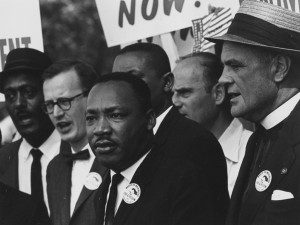 On Monday our nation sets aside time to recognize the legacy of Dr. Martin Luther King, Jr. While growing up in Alabama, I lived 150 miles from where he marched in Selma. For 17 years living in Arkansas, I lived 100 miles from where he was killed in Memphis. It is undeniable that he played a significant role in a time of turmoil and change. Regardless of what people may think about the man, his methods or his politics, for many he symbolizes the desire for unity, service and concern for our fellow man. You have probably heard his “I Have a Dream” speech repeated around this time of year. Below is a section of another speech he gave the day before his assassination.
“Let us develop a kind of dangerous unselfishness. One day a man came to Jesus, and he wanted to raise some questions about some vital matters of life. At points he wanted to trick Jesus, and show him that he knew a little more than Jesus knew and throw him off base. Now that question could have easily ended up in a philosophical and theological debate. But Jesus immediately pulled that question from mid-air, and placed it on a dangerous curve between Jerusalem and Jericho. And he talked about a certain man, who fell among thieves. You remember that a Levite and a priest passed by on the other side. They didn’t stop to help him. And finally a man of another race came by. He got down from his beast, decided not to be compassionate by proxy. But he got down with him, administered first aid, and helped the man in need. Jesus ended up saying, this was the good man, this was the great man, because he had the capacity to project the ‘I’ into the ‘thou,’ and to be concerned about his brother.”
That kind of concern for brothers is something the young church at the end of Acts 2 places a lot of importance on. They learned together. They prayed together. They shared what they had. They took care of one another’s needs. Their number grew as a result.
So many of the things that God tells us to do involve how we treat each other. Honor your father and mother. Turn the other cheek. Forgive. Value others above yourselves. Love your neighbor.
To be followers of Christ we have to see every person we encounter as a valuable creation of the Father. Each person is someone that He wants to bring closer to Him. It is up to us to show them His love. It’s not always easy, and it might be a little uncomfortable. Maybe we all should develop that same kind of dangerous unselfishness that Dr. King spoke about.
Staying Connected and Staying Found
 Since becoming a Christian as an 8th grader, I have probably heard the word “lost” in church contexts more than anywhere else in life. We are concerned about reaching the lost, because Jesus said the reason He came to earth was “to seek and save the lost” (Luke 19:10). In fact, Paul tells Timothy that God “desires all people to be saved and to come to the knowledge of the truth” (1 Timothy 2:4). As wonderful as it is to see someone come to salvation through Christ, we know that too often the found end up getting lost again.
Luke 15 relates the plight of the lost and the One who desperately wants to find them through parables of the lost sheep, the lost coin and the lost son. Although each is lost for a different reason (negligence, wandering or choice), the result is the same. They are lost.
In the book The Great Dechurching: Who’s Leaving, Why Are They Going, and What Will It Take to Bring Them Back?, the authors surveyed people who have left churches for a number of reasons. The various reasons people leave are compounded by the lack of connection or belonging. That is a problem that we can all work to improve. The book describes it this way.
“If we claim to believe and behave but do not belong, we become a lone ranger Christian. While we have a category for shut-ins and other challenging circumstances, the Bible seems fairly clear that we are a people who gather together physically. Our lack of belonging is in itself a behavioral issue. The author of Hebrews tells us not to neglect meeting together. In every city where the gospel was preached in Acts, the new believers were connected to a local church. We are given dozens of ‘one anothers’ in Scripture that can only be carried out as we belong to a local church. When we neglect the Bible’s exhortations to belong, we can become stagnant and dull in our faith.”
We need to encourage one another not to neglect meeting together, not to become stagnant and not to be disconnected; but it can still be easy for someone to drift away unnoticed like that lost coin. Let’s all look out for one another and encourage one another to stay connected!
Brian
“Abide in me, and I in you. As the branch cannot bear fruit by itself, unless it abides in the vine, neither can you, unless you abide in me. I am the vine; you are the branches. Whoever abides in me and I in him, he it is that bears much fruit, for apart from me you can do nothing.” – John 15:4-5
Lonely or Connected?
 In the U.S. today, people are probably as isolated and lonely as they have been at any point in history. It seems strange, because we also have more ways to connect than at any point in history. How can both of those seemingly opposite statements be simultaneously true? Does that problem extend into the life of the church?
In his book, Why Do We Feel Lonely at Church?, Jeremy Linneman addresses the epidemic of loneliness. “I’ve studied loneliness, belonging, and community, and I’m convinced we don’t fully understand the pervasiveness of individualism—and how much it is hurting us as believers. To what extent do Christians experience loneliness? And how can the church respond to the loneliness epidemic?”
God designed the church to be a place where we are connected. When you think of the various analogies used in scripture, connection is necessary and assumed. The church is the branches attached to the Vine, the body and His family—all things that depend on and thrive through connection. Still, many can feel disconnected. We should not be content with that.
Linneman has a word of encouragement or motivation for us. For the introverts, it might even be a challenge, but it is a worthwhile one. “If you are finding it hard to make friends, you’re not crazy. Friendship is challenging in a society like this—even in the church. But the answer is not to lower your expectations and prepare for loneliness. The answer is to confront the challenge directly, reject the isolation and division of our times, and embrace real, meaningful, face-to-face relationships with imperfect people. By God’s grace and intentional steps, we can do this. You belong here.”
Like so many things in life, it will take our effort to connect in deeper community. Let’s keep connecting as family here at Southwest. That’s the plan God has for us.
Brian
For just as the body is one and has many members, and all the members of the body, though many, are one body, so it is with Christ. – 1 Corinthians 12:12
Empathy
 It is rare that I read a book just based on the title, but the book I am reading now is one I started for that exact reason. The book is Learning to Disagree: The Surprising Path to Navigating Differences with Empathy and Respect by John Inazu. Maybe that title appeals to you as well. When I think of how disagreements tend to play out in America in 2024, empathy and respect are not usually words I would use to describe the sides I see in disagreement. In fact, they are often as far away as I could imagine. I am only in chapter two, so this is not a recommendation yet. However, the author asks a question in chapter one that is important to people in general, but especially important to people who are supposed to be known for our love.
“How do we learn empathy?”
I think most of us are good at empathy with people who are like us or people who are dealing with similar challenges in life. We might struggle more with people who come from different backgrounds, think differently and have values or hold opinions we disagree with. Yet we are still called to love people like that. That love calls us toward empathy. The kind of empathy described in this book sounds quite a bit like the empathy we find in scripture. Inazu says this about empathy:
“Empathy is not rocket science. It’s hearing an unfamiliar or off-putting argument, pausing to think about what has been said and responding with an appropriately engaged question. It’s giving people the benefit of the doubt because you may not know what battles they are fighting. It’s treating others the way you would like to be treated. Empathy is the simple stuff that’s hard to put into practice.”
“Empathy is not rocket science. It’s hearing an unfamiliar or off-putting argument, pausing to think about what has been said and responding with an appropriately engaged question. It’s giving people the benefit of the doubt because you may not know what battles they are fighting. It’s treating others the way you would like to be treated. Empathy is the simple stuff that’s hard to put into practice.”
In short, hear, pause, respond appropriately and give the benefit of the doubt. As followers of Jesus, we should lead the way on empathy. It is the example He gave us when He encountered people who others dismissed. He is the one who taught us that people who are come from different backgrounds, think differently and have values or hold opinions we disagree with are still our neighbors. Let’s strive to love and understand them better.
Brian
“Put on then, as God’s chosen ones, holy and beloved, compassionate hearts, kindness, humility, meekness, and patience, bearing with one another and, if one has a complaint against another, forgiving each other; as the Lord has forgiven you, so you also must forgive.” – Colossians 3:12-13
Faith In Troubled Times
 On Sunday evenings in April, we are talking about faith and doubt. As we discussed last week, a common faith problem is that we sometimes put our faith in the wrong things. People trust their resources, themselves or others above God. Even though faith was placed elsewhere, the same people might blame God when things do not go according to plan. When those things and people let us down and circumstances get worse, God remains. He was there before, but His people can be too busy making their own solutions to see His presence clearly.
Amazingly, He told us in scripture that He works that way. Sometimes He shows us through the example of who He chooses to be part of His mission. Author Jon Acuff captures this idea well. “God found Gideon in a hole. He found Joseph in a prison. He found Daniel in a lion’s den. He has a curious habit of showing up in the midst of trouble, not the absence. Where the world sees failure, God sees future. Next time you feel unqualified to be used by God remember this, he tends to recruit from the pit, not the pedestal.”
When we don’t pick up on the pattern in examples like these, He even spells it out for us through the words of Paul in 2 Corinthians 12:7-10. “So to keep me from becoming conceited because of the surpassing greatness of the revelations, a thorn was given me in the flesh, a messenger of Satan to harass me, to keep me from becoming conceited. Three times I pleaded with the Lord about this, that it should leave me. But he said to me, “My grace is sufficient for you, for my power is made perfect in weakness.” Therefore I will boast all the more gladly of my weaknesses, so that the power of Christ may rest upon me. For the sake of Christ, then, I am content with weaknesses, insults, hardships, persecutions, and calamities. For when I am weak, then I am strong.”
So where is our faith? It is in our all-powerful God, whose power is shown in our weakness. Those moments of weakness that could challenge our faith can actually be reminders of His power. May that strengthen our faith!
Brian
A Faith That Grows
 I love stories in scripture of faith that progresses in the lives of people who encounter Jesus. We looked at one of those stories last month in John 9. The blind man who Jesus heals changes the way he describes Jesus as the chapter goes on. He calls Jesus a man, then calls Him a prophet and recognizes that He must be from God before finally calling Him Lord towards the end of the chapter. There is a similar faith progression that happens in the life of another person mentioned in a few instances throughout John’s gospel.
We are first introduced to Nicodemus in John 3. He comes to learn from Jesus at night. Although it is not spelled out for us, that timing of his visits with Jesus indicate that he does not want to be seen with Him. Jesus explains to him that a person must be born again to have a new life with God. He is clearly confused by this teaching, but we do not know in chapter 3 if his life is changed.
We next find Nicodemus in John 7. Jesus has gained popularity, but people are divided about who He is and what His teaching and miracles might mean. As the Pharisees are ready to condemn, Nicodemus speaks up in verse 51: “Does our law judge a man without first giving him a hearing and learning what he does?” There are not many people in John’s gospel other than Jesus who challenge the Pharisees. Nicodemus does here.
We last hear about Him in chapter 19 after Jesus is crucified. Nicodemus and Joseph of Arimathea take the body of Jesus and place Him in the tomb. In verse 39, John reminds us who he is and tells us what he does now. “Nicodemus also, who earlier had come to Jesus by night, came bringing a mixture of myrrh and aloes, about seventy-five pounds in weight.”
Nicodemus went from visiting under the cover of darkness, to speaking words of reason in a tense situation to caring for Jesus after His own apostles were nowhere to be found. What changed from chapter 3 to chapter 19? He encountered Jesus. If Jesus could transform Nicodemus so completely, how could He change your life?
Nicodemus went from visiting under the cover of darkness, to speaking words of reason in a tense situation to caring for Jesus after His own apostles were nowhere to be found. What changed from chapter 3 to chapter 19? He encountered Jesus. If Jesus could transform Nicodemus so completely, how could He change your life?
Brian
“But whoever does what is true comes to the light, so that it may be clearly seen that his works have been carried out in God.” – John 3:21
Ebb and Flow
 According to the Merriam-Webster Dictionary, ebb and flow is “used to describe something that changes in a regular and repeated way.“ That could describe many things in our world. We experience the changing of seasons in nature. Baseball fans are ready tor a new season to begin. We are only a couple of months away from another school year coming to an end. Even in church life, there are regular changes.
Last Sunday, Stacey and I visited the congregation in Arkansas where we spent 14 years. Although it was good to reconnect with old friends, we were struck by how many familiar faces were gone and had been replaced by new faces we did not know. Here at Southwest, we experience the same thing.
Within the last few months, the Neill and Conley families have both moved away. Although I have no doubt they will be great additions to new congregations, they will be missed here. Their entire families were active in so many of the ministries that make Southwest the church family that it is. They will be hard to replace, yet the work they did here still needs to be done.
We have suffered losses as people we love dearly have gone on to their reward. We celebrate lives well lived to God’s glory. We know we will meet again, but their absence here is still felt.
We have suffered losses as people we love dearly have gone on to their reward. We celebrate lives well lived to God’s glory. We know we will meet again, but their absence here is still felt.
On the other side of the ebb and flow, we have regular additions and changes to our church family. New members have joined us. Some are old friends, while others are new ones. The sounds of babies and children are a regular part of our gatherings. We have rejoiced as we witnessed transformed lives rise from the waters of baptism.
The ebb and flow is all part of the life of the church. It is such a blessing to be a part of the Southwest family. The God who unites us is the One who will always remain.
Brian
For everything there is a season, and a time for every matter under heaven. – Ecclesiastes 3:1